

%20(2).svg)

Posted by Satoru Kumashiro, January 22, 2026
Choosing the Right Architecture for Your Edge AI Device
Edge AI, processing data directly on devices instead of in the cloud, is rapidly becoming the standard for real-time, efficient, and cost-effective machine intelligence. However, with many hardware architecture choices available, it can be confusing to decide the best fit for your product requirements.
Before diving in, it helps to think in terms of three key needs common to most edge AI systems:
- Inference performance (how fast and accurate your AI runs)
- Power & thermal efficiency (critical for battery-powered or always-on devices)
- Integration cost & development complexity
Below we’ll compare common edge AI architectures and show where the EP-200Q shines as a powerful, efficient, and development-friendly platform.
1. SoC with Integrated NPU/Accelerator
This would be best for compact, cost-sensitive devices.
Typical traits include:
- Low power and very compact footprint
- Generally supports quantized models (e.g., int8/int16)
- Limited memory and model size
When to pick this: Simple AI tasks where power, cost, and size are the priority (e.g., simple sensor boxes or tiny AI cameras).
Limitations: Not ideal for larger models or high-resolution vision tasks.
In sum, this category is great for simple edge inference at the device level but starts to struggle when higher accuracy or richer data (like multi-camera vision) is required.
2. SoC with Integrated GPU/Accelerator
This is best for edge computers needing higher accuracy in a moderate form factor.
- Handles larger models (including FP32)
- More RAM (commonly 4GB –128 GB)
- Moderate to high power use
Possible Use cases: Centralized units processing for multiple sensors or devices, industrial gateways, and sophisticated vision nodes.
Possible Trade-offs: Power goes up, footprint grows, and development can get more complex.
3. Discrete AI Accelerator Modules:
This is best for retrofitting AI into existing platforms or modular systems
- Pluggable form factors (e.g., PCIe, USB)
- Higher performance than most embedded NPUs
- Larger physical footprint
When to use: Systems where computation needs to evolve over time and you want flexibility to upgrade AI co-processors.
Considerations: Adds complexity in system integration compared to integrated SoC solutions.
4. Discrete GPUs:
This is best for high-end systems with demanding graphics and deep learning workloads.
Typical traits include:- Massive parallel compute power (> 1,000 TOPS with sparse models)
- Large form factors, high power budgets
Ideal for: x86 platforms running heavy AI, simulation, or graphics along with AI inference.
Limitations: Size, power, and cost often put this beyond embedded/edge constraints.
Summary table:
|
Architecture |
Use Case |
Model Support |
Memory Range |
Power Consumption |
Form Factor |
Scalability |
|
SoC with Integrated NPU/Accelerator |
Compact embedded devices with cost efficiency |
int8, int16 FP16 in some models |
Limited (embedded memory) |
Low |
Very compact |
Limited, device-level |
|
SoC with Integrated GPU/Accelerator |
Edge computers requiring higher accuracy in moderate form factor |
FP32 and others |
4GB-128GB RAM |
Moderate to High |
Compact to mid-size |
Moderate, centralized edge |
|
Discrete AI Accelerator |
Modular upgrades or shared SoC across products |
int8, int16 FP32 in some models |
Depends on host system |
Moderate |
Larger footprint (USB/PCIe) |
High, modular and flexible |
|
Discrete GPU |
High-performance systems with intensive AI and graphics needs |
FP32 and others, int8 sparse (>1000 TOPS) |
Large (system dependent) |
High |
Large (soldered or GPU board) |
Very high, supports parallelism |
Where the EP-200Q Fits In:
If your target use case involves vision-centric, real-time AI at the edge, the EP‑200Q offers an optimized sweet spot between performance, power efficiency, connectivity, and developer friendliness.
Why Silex’s EP-200Q Is a Strong Choice for Edge AI:
High-Efficiency AI Performance:
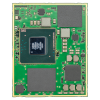
Powered by Qualcomm Dragonwing QCS6490, the EP-200Q delivers up to 12 TOPS of AI performance, powerful enough for various vision, robotics, and automation tasks, while remaining efficient for battery-powered and always-on systems.
Designed for Vision AI Workloads:
With support for up to five MIPI CSI cameras, the module is ideal for machine vision and computer vision systems like smart cameras, autonomous robots, or inspection devices, letting you run inference directly at the source with minimal latency.
Always-On Connectivity:
Pre-validated integration with high-performance Wi-Fi 7 connectivity, (and optional Wi-Fi/Bluetooth combos) simplifies wireless design and boosts reliability, a major benefit over basic SoC designs without built-in connectivity stacks.
Compact Yet Versatile Form Factor
At just 35 × 40 mm, the EP-200Q’s small footprint makes it suitable for constrained embedded designs without forcing compromise on compute or connectivity.
Simplified Development & Support:
As a Qualcomm-certified design center, Silex provides SDKs, Wi-Fi drivers, documentation, and engineering support, all helping startups and OEMs accelerate development and reduce time to market.
Recommendation:
For many modern edge AI products that do machine vision, smart automation, or robotic perception, a SoC-based platform with strong AI capabilities and built-in connectivity, like the EP-200Q, often delivers the best balance of performance, power, and developer experience.
Conclusion
Each architectural choice has its place, but for vision-driven, real-time edge AI devices, choosing a robust embedded SoM with efficient compute, rich camera interfaces, and reliable connectivity can significantly streamline development and improve product outcomes. The EP-200Q is engineered precisely for this space, combining high AI throughput, comprehensive interfaces, and long-term support to help you go from prototype to production faster and more reliably.
Ready to learn more? Explore the full details of the EP-200Q to see how it fits your next edge AI project. Have questions? Ask our team.