

%20(2).svg)

On February 4 2026, Silex Technology partnered with NXP Semiconductors to host a live webinar exploring one critical question facing today’s medical and industrial system designers:
Is traditional Wi-Fi still enough?
The session, Built to Perform: Why Tri-Band Wi-Fi 6E Is a Requirement for Next-Gen Medical and Industrial Devices, delivered a clear and compelling answer. As wireless connectivity becomes foundational to system operation, performance is no longer about peak speed. It’s about reliability, determinism, and scalability.
Below is a recap of the key themes and takeaways.
Connectivity Has Become Mission-Critical
Modern medical and industrial environments are placing unprecedented demands on wireless networks. Hospitals, factories, and edge deployments now support:
- Thousands of concurrent devices
- A mix of human and machine traffic
- Critical and non-critical data sharing the same infrastructure
In these environments, connectivity directly impacts outcomes. Latency spikes, packet loss, or unpredictable airtime contention are no longer inconveniences, they are system-level failures. Whether enabling patient monitoring, industrial automation, machine vision, or edge computing, failure is simply not an option.
Why Legacy Dual-Band Wi-Fi Falls Short
Traditional dual-band Wi-Fi (2.4 GHz and 5 GHz) was never designed for today’s scale and diversity of traffic. As device density increases, these legacy bands suffer from:
- Limited available spectrum
- High contention and congestion
- Unpredictable latency under load
The result is degraded reliability in environments that demand consistent, deterministic behavior.
The 6 GHz Advantage: Clean Spectrum, Predictable Performance
A major takeaway from the webinar was the importance of the 6 GHz band, enabled by Wi-Fi 6E. Unlike legacy spectrum, 6 GHz offers:
- Significantly lower interference
- More available channels for high-density deployments
- Improved determinism for latency-sensitive applications
For applications such as high-resolution medical imaging, real-time control, XR, and continuous vital sign monitoring, clean spectrum directly translates into reliable performance.
Tri-Band Wi-Fi 6E: Not an Upgrade, a Requirement
Tri-band Wi-Fi 6E allows systems to intelligently distribute traffic across 2.4 GHz, 5 GHz, and 6 GHz, creating architectural headroom as wireless becomes embedded into core system design.
This enables a single network to support:
- Low-bandwidth, always-on telemetry
- High-bandwidth imaging and video
- Latency-sensitive real-time control traffic
The conclusion from the session was clear: tri-band Wi-Fi 6E isn’t a nice-to-have, it’s a requirement for next-generation medical and industrial devices.
NXP IW623: Built for Medical and Industrial Connectivity
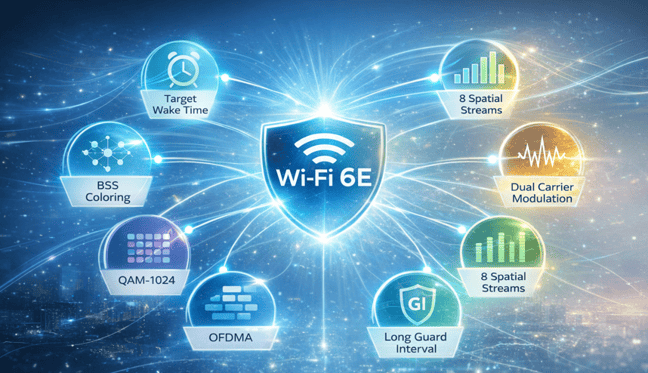
NXP highlighted the IW623, a 2x2 tri-band Wi-Fi 6E and Bluetooth® 5.3 combo chipset purpose-built for IoT, industrial, and healthcare applications.
Key capabilities include:
- Concurrent operation across 2.4, 5, and 6 GHz bands
- Support for MU-MIMO, OFDMA, and Target Wake Time (TWT)
- Dedicated CPUs and memory for Wi-Fi and Bluetooth subsystems
- Integrated EdgeLock® security, secure boot, and lifecycle management
- Industrial temperature support (-40°C to +85°C)
Together, these features deliver high performance, strong security, and predictable behavior in demanding environments.
Intelligent Features for Real-World Networks
Beyond raw radio performance, NXP shared several enhancements designed to address real-world deployment challenges:
- Low Latency Data Exchange (LLDE): Improves link timing to reduce collisions and latency
- Adaptive Scheduling: Dynamically allocates resources to support large numbers of connected devices
- Agile Channel Switching: Quickly moves to cleaner channels to maintain throughput in noisy environments
- Advanced Power Management: Dynamic transmit power control and optimized sleep modes
These capabilities improve stability, scalability, and power efficiency, especially in dense medical and industrial settings.
Reducing Risk with a Trusted Module Partner
Silex Technology emphasized the value of working with an experienced module partner to reduce complexity and accelerate time to market.
Key benefits include:
- Pre-certified modules that dramatically reduce regulatory cost and risk
- Validated performance across enterprise access point ecosystems
- Production-ready form factors with comprehensive engineering support
- Fully tested Linux software stacks that simplify integration
- Wi-Fi should just work
- Devices shouldn’t have to worry about connectivity
- Outcomes depend on it
With Wi-Fi 6E certification costs approaching $250,000, leveraging pre-certified modules is a critical strategy for managing risk and controlling development costs.
Final Takeaway
As the webinar concluded, one message resonated strongly:
Tri-band Wi-Fi 6E, combined with robust silicon, advanced security, and proven module expertise, provides the reliable foundation required for next-generation medical and industrial devices.
Missed the webinar? Catch the replay below.