

%20(2).svg)

Edge AI systems are no longer confined to controlled environments or cloud-assisted workflows. In production deployments such as autonomous mobile robots, industrial inspection systems, medical imaging devices, and Vision AI cameras, intelligence must operate locally, continuously, reliably, and under real-world constraints.
This shift exposes a critical reality in embedded system design: edge AI performance is not determined by compute alone. Connectivity stability, thermal behavior, camera subsystem integration, and long-term software support increasingly define whether a platform succeeds in production or fails during deployment scaling.
For many OEMs, this complexity emerges only after prototyping. A system that performs well in controlled conditions can degrade quickly when exposed to factory-floor interference, roaming wireless environments, sustained inference workloads, or multi-camera sensor pipelines.
As a result, selecting an edge AI System-on-Module has become less about raw specifications and more about architectural completeness, how well compute, connectivity, I/O (input/output) and software ecosystem are integrated into a deployable system.
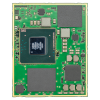
The EP-200Q Edge AI SoM from Silex Technology is designed around this reality. Built on the Qualcomm® Dragonwing™ QCS6490 platform and engineered with integrated industrial wireless capabilities and Vision AI-ready I/O, it targets the system-level challenges that determine whether edge AI deployments scale beyond proof-of-concept.

1. Edge AI Performance Must Reflect Real Deployment Workloads
Edge AI workloads vary significantly across industrial, medical, and robotics systems. A single inference benchmark does not reflect the sustained, multi-modal processing required in production environments.
In medical imaging systems, workloads often involve continuous image processing under strict power constraints. In robotics, edge compute must support sensor fusion, multi-camera perception, and real-time decision-making simultaneously. In industrial Vision AI systems, high-throughput inspection pipelines require consistent low-latency inference without thermal degradation.
The challenge for system designers is not peak performance, it is sustained performance under load while maintaining deterministic behavior.
The EP-200Q Edge AI SoM, built on the Qualcomm® Dragonwing™ QCS6490 platform, delivers up to 12 TOPS of AI acceleration in a compact form factor. More importantly, it is designed for continuous edge inference workloads where compute, memory, and I/O must operate in coordination across long-duration deployments.
By enabling local inference at the edge, systems can reduce dependency on cloud round-trips, improve response time, and maintain operation even in constrained or intermittent network environments.
2. Connectivity Reliability Is a System-Level Requirement, Not an Add-On
In production edge AI deployments, system failure is often caused less by compute limitations and more by connectivity instability.
Robotics platforms experience frequent roaming events across access points. Industrial environments introduce RF interference and unpredictable signal degradation. Medical and monitoring systems require consistent connectivity for data continuity and safety compliance.
These conditions expose weaknesses in generic wireless implementations, particularly when connectivity is treated as an external module rather than a system-integrated component.
The EP-200Q integrates with Silex’s Wi-Fi 7 driver support for the SX-PCEBE module, helping ensure reliable wireless connectivity for edge AI and industrial applications. This approach enables tighter coordination between compute and wireless subsystems, reducing variability introduced by fragmented hardware and driver stacks.
For applications such as autonomous mobile robots, factory inspection systems, and connected medical devices, this level of integration directly impacts uptime, determinism, and deployment scalability.
Want to see how Wi-Fi 7 impacts real edge AI deployments?
Join our upcoming webinar to explore how integrated connectivity architectures improve reliability in robotics, industrial systems, and Vision AI applications under real-world RF conditions.
Reserve Your Webinar Seat3. Thermal and Power Constraints Define Real Edge AI Limits
In compact embedded systems, peak AI performance is rarely the limiting factor, thermal and power constraints are.
Edge AI systems deployed in robotics platforms, handheld industrial devices, and medical equipment must sustain inference workloads without active cooling overhead or thermal throttling. In these environments, performance stability over time is more important than short bursts of high compute output.
Designing for these constraints requires balancing AI acceleration, power efficiency, and physical system footprint as a unified engineering problem.
Built on the Qualcomm® Dragonwing™ QCS6490 processor, the EP-200Q Edge AI SoM delivers high-performance inference in a compact 35mm × 40mm design suited for power- and thermally constrained edge systems.
This allows OEMs to reduce external thermal design complexity while maintaining predictable performance across continuous operation scenarios.
4. Vision AI Systems Depend on Integrated Sensor and I/O Architecture
Vision AI applications place unique demands on edge AI platforms due to their reliance on high-bandwidth sensor input and real-time processing pipelines.
Use cases such as automated optical inspection, robotics navigation, smart surveillance, and medical imaging require tight synchronization between camera inputs, compute acceleration, and system I/O.
Fragmented sensor integration can become a bottleneck, increasing development time and limiting scalability across product lines.
By reducing integration overhead between imaging systems and compute pipelines, the platform simplifies development of industrial inspection systems, robotics vision stacks, and embedded medical imaging devices.
5. Scalability and Lifecycle Support Determine Production Success
In industrial and medical markets, initial performance validation is only the first step. Long-term success depends on platform stability, software continuity, and lifecycle availability.
Edge AI systems deployed in regulated or mission-critical environments often require multi-year support cycles, stable driver ecosystems, and predictable hardware availability.
Without this stability, engineering teams are forced to re-qualify systems, rewrite software stacks, or redesign hardware mid-lifecycle, significantly increasing cost and risk.
The EP-200Q Edge AI SoM includes Yocto Linux SDK support and a development ecosystem designed for long-term embedded deployment. This enables OEMs to transition from prototype to production with reduced platform churn and more predictable software maintenance paths.
Conclusion: From Edge AI Prototype to Production
As edge AI moves deeper into industrial automation, robotics, medical devices, and Vision AI applications, the defining challenge is no longer whether models can run at the edge, but whether the entire system can operate reliably at the edge under real deployment conditions.
In production environments, performance bottlenecks rarely originate from AI inference alone. Instead, system instability is often introduced by fragmented wireless implementations, thermal throttling under sustained workloads, or integration complexity between compute, camera inputs, and connectivity subsystems.
Platforms that succeed at scale are those that minimize these points of friction by design, reducing the number of subsystems developers must integrate, validate, and maintain independently.
The EP-200Q Edge AI SoM is positioned in this context: not as a compute module alone, but as a pre-integrated edge AI foundation combining processing capability, industrial-grade connectivity, vision AI support, and a long-term embedded software ecosystem designed for deployment lifecycle requirements.
For engineering teams moving from prototype validation to production rollout, this system-level integration can materially reduce development risk, shorten integration cycles, and improve deployment stability across industrial, medical, and robotics applications.
Engineering Deep Dive
To understand how these architectural decisions translate into real-world deployment patterns, including Wi-Fi 7 reliability in mobile robotics and vision AI applications, join the upcoming EP-200Q Edge AI webinar.
Ready to move from evaluation to deployment?
Join the EP-200Q Edge AI webinar featuring Edge Impulse to see how a system-level SoM approach simplifies integration across compute, connectivity, and Vision AI pipelines in real industrial environments.
Join the Webinar