

%20(2).svg)

The NXP i.MX 95 is an applications processor family that combines up to six Arm® Cortex®-A55 cores, an integrated eIQ® Neutron NPU, an NXP-developed image signal processor (ISP), advanced security features including the EdgeLock® Secure Enclave, and dedicated real-time and safety domains.
What Is the NXP i.MX 95?
The i.MX 95 is NXP's i.MX 9 applications processor family designed for secure, power-efficient edge computing. Up to six Arm® Cortex®-A55 cores provide application processing, while an Arm Cortex-M7 supports real-time processing and an Arm Cortex-M33 supports the safety and low-power domain. An Arm Mali™ GPU supports graphics, an integrated ISP supports image processing and camera applications, and the NXP eIQ® Neutron NPU accelerates machine learning workloads.
Rather than focusing only on AI performance, the platform brings together AI-accelerated vision processing, security, functional safety and high-performance connectivity for edge applications.
What Are the Benefits of the i.MX 95?
On-device machine learning. The eIQ Neutron NPU accelerates machine learning inference as part of a vision processing pipeline, including applications using multiple camera sensors or network-attached smart cameras. NXP's eIQ software environment provides tools to support machine learning development and deployment.
Built-in security. The EdgeLock® Secure Enclave helps implement security-critical functions such as secure boot, cryptography, trust provisioning and run-time attestation.
Functional safety support. The i.MX 95 includes an independent safety domain built around an Arm Cortex-M33, alongside a real-time domain based on the Cortex-M7. NXP identifies the platform as supporting IEC 61508 SIL 2 for industrial applications and ISO 26262 ASIL-B for automotive applications. Certification and compliance of the end product depend on the complete system design and implementation.
Power management. NXP's Energy Flex architecture provides fine-grained, independent power management for the application and safety domains, helping developers optimize power consumption according to system requirements.
What Is the Silex EP-200N?
The EP-200N is a compact, surface-mount AMC Edge SoM powered by the i.MX 95. It features a hexa-core Cortex-A55 architecture with an integrated GPU, VPU, and ISP, plus a 2-TOPS NPU (8 eTOPS effective) for vision and sensor processing. It also provides integrated Ethernet and CAN-FD interfaces.
For wireless, the EP-200N integrates with the SX-SDMAX6E Wi-Fi 6E SDIO module, and the EP-200N Yocto Linux package includes the validated SX-SDMAX6E driver.
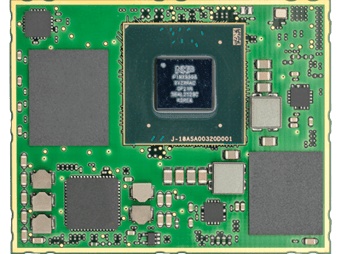
A SoM gives teams a pre-engineered computing foundation, so they can build a carrier board around it and focus on the application instead of designing the core processing platform from scratch.
What Is the i.MX 95 Used For?
- Industrial automation: machine vision, equipment monitoring, and CAN-FD-connected equipment.
- Medical and healthcare devices: connected devices that need secure, reliable edge processing. Device-level regulatory requirements still apply.
- Industrial HMI and connected equipment: graphics, networking, and local AI processing on one platform.
FAQ
Is the i.MX 95 good for edge AI?
It can be, for vision and sensor workloads that fit its NPU. Silex's EP-200N NPU is rated at 2 TOPS (8 eTOPS effective), but actual performance depends on your model, so it's best to test your own workload.
Does the EP-200N support Wi-Fi?
Yes, when paired with the SX-SDMAX6E Wi-Fi 6E module.
Which Silex SoM uses the i.MX 95?
The EP-200N. For the Qualcomm QCS6490, see our EP-200Q.
Evaluate the EP-200N
Evaluate the EP-200N with your own camera, model, and peripherals through Silex's Early Access Program.