


Posted by Sarah Torjman, November 6, 2026
Wi-Fi 6E for Industrial Devices: NXP IW693 Module Guide
Industrial devices need Wi-Fi that survives crowded spectrum, wide temperature swings, and product lifecycles measured in decades. Wi-Fi 6E and the NXP IW693 chipset tackle the first problem directly, but the module around the chip decides whether the other two get solved.
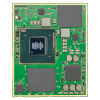
This guide covers what industrial design teams should look for in a Wi-Fi 6E and Bluetooth module, using the Silex SX-SDMAX6E-DW, an SDIO module built on the NXP IW693S, as the example.
Why industrial Wi-Fi is harder than it looks
A Wi-Fi connection that works on the bench can fail on the plant floor.
- Congested bands. Access points, handhelds, and nearby equipment compete for the same 2.4 GHz and 5 GHz channels.
- Mobile equipment. Carts and handheld terminals need roaming that doesn't drop sessions.
- Harsh environments. Hot enclosures, cold storage, and metal surfaces all affect RF performance.
- Long product lives. Industrial products ship and are serviced for 10 years or more, far longer than most Wi-Fi chipsets stay in production.
What the NXP IW693 brings
The IW693 is a Wi-Fi 6/6E and Bluetooth combo solution with Concurrent Dual Wi-Fi (CDW). In its top configuration, it runs a 2x2 Wi-Fi 6/6E connection on 5-7 GHz alongside a 1x1 Wi-Fi 6 connection on 2.4 GHz. The IW693S uses an SDIO host interface and the IW693P uses PCIe. For the trade-offs between the two, see our post When Should You Choose an SDIO Wi-Fi Module Over PCIe?
6 GHz on the factory floor
The 6 GHz band adds a large block of spectrum with no legacy Wi-Fi 4 or Wi-Fi 5 traffic. In a busy facility, that means more clean channels, fewer retries, and more predictable latency.
Two planning points:
- Plan for range. Higher frequencies lose more signal through walls and equipment, so 6 GHz coverage may need denser access point placement.
- Check your regions. The US allows 5,925-7,125 MHz for Wi-Fi, while Europe (5,945-6,425 MHz), the UK, and Japan (5,925-6,425 MHz) currently allow only the lower portion. Allocations vary by country and are still evolving, so products sold in multiple regions need region-specific channel settings.
The module also supports 2.4 GHz and 5 GHz, so a device can use whatever the site's network offers.
Concurrent dual wireless in a plant
CDW lets a device run two Wi-Fi interfaces independently and at the same time, in station or access point mode, instead of switching one radio between roles. In industrial settings, that means a device can:
- Join the plant network on 5 or 6 GHz while hosting a local access point on 2.4 GHz for technician tools or diagnostics.
- Keep high-bandwidth data and low-bandwidth control traffic on separate bands.
- Roam between access points as it moves through a facility.
The SX-SDMAX6E-DW offers six operating modes: four from NXP and two added by Silex to further optimize power consumption, including 1x1 configurations for designs that don’t need full 2x2 throughput.
Built for the temperature range and the timeline
The SX-SDMAX6E-DW is specified for operation from -40 to 85 °C. Industrial-grade performance also depends on testing across that full range, not only choosing qualifying components. Lifecycle matters just as much:
- 10-15 year lifecycle. The IW693 family is supported under NXP's 10-15 year lifecycle program.
- Component stocking. Silex stocks components and runs its own manufacturing, so it can keep building products after an underlying component reaches end of life.
- TAA compliant. The module is built at Silex's factory in Kyoto, Japan.
One platform from SDIO to PCIe
Industrial manufacturers rarely build one product. They build families, with some devices that are power-sensitive and others that need more throughput. Maintaining a different driver and certification for each can become a major cost.
Silex’s IW693 modules are built on a common architecture. The SX-SDMAX6E-DW covers SDIO designs and the SX-PCEAX-LP covers PCIe designs, so teams that maintain a BSP across products with different performance and power needs can simplify Wi-Fi driver maintenance.
From reference driver to production
As an NXP Gold Partner, Silex works closely with NXP to deliver optimized driver software that enhances performance, stability, and ease of integration. Silex provides free drivers for the NXP i.MX9x platform, along with software, hardware, certification, and production support.
Frequently asked questions:
What is the NXP IW693?
The IW693 is an integrated Wi-Fi 6/6E and Bluetooth/Bluetooth LE solution with concurrent dual Wi-Fi (CDW). NXP defines four operating modes: CDW with 2x2 Wi-Fi 6/6E on 5-7 GHz plus 1x1 Wi-Fi 6 on 2.4 GHz, CDW with 1x1 on both bands, 2x2 Wi-Fi 6 on 2.4 GHz alone, and 2x2 Wi-Fi 6/6E on 5-7 GHz alone. It is available with an SDIO (IW693S) or PCIe (IW693P) host interface.
Is the SX-SDMAX6E-DW suitable for industrial use?
Yes. It is designed for medical and industrial embedded applications and is specified for -40 to 85 °C operation.
Why use 6 GHz Wi-Fi in a factory?
The 6 GHz band has more channels than 5 GHz and no legacy Wi-Fi traffic, which reduces interference. Plan coverage carefully, since 6 GHz attenuates more than lower bands.
What form factors are available?
SMT (SX-SDMAX6E-DW-2530S) and M.2 2230 (SX-SDMAX6E-DW-M2).
Choose the Right Module for Your Industrial Design
Compare Wi-Fi 6/6E/7 embedded wireless modules, including SDIO and PCI Express architectures, the SX-PCEAX and SX-PCEAX-LP, and CDW operating modes to find the right solution for your industrial design.