

%20(2).svg)

Edge AI has moved from concept to necessity across industries, from manufacturing and robotics to smart infrastructure. Yet, despite rapid advances in hardware and tooling, many teams still struggle to move from promising prototypes to reliable, real-world deployments. The gap isn’t just technical, it’s operational.
This article explores the core challenges of implementing edge AI and how a combined approach using the EP-200Q-EVK and Edge Impulse (a Qualcomm Company) helps address them in a practical, scalable way.
Why Edge AI Implementation Is Still Difficult
While cloud-based AI development is relatively mature, edge AI introduces constraints that fundamentally change how models must be designed, trained, and maintained.
1. Resource Constraints
Edge devices operate within strict limits on compute, memory, and power. Even efficient models can struggle when deployed on hardware that must balance multiple workloads. This often results in:
- Increased inference latency
- Reduced throughput
- Trade-offs between accuracy and performance
2. Data Discrepancy
Models are typically trained on curated datasets collected under controlled conditions. However, real-world environments introduce variability:
- Lighting changes
- Sensor noise
- Installation differences
These discrepancies can significantly degrade model accuracy after deployment.
3. Operational Complexity
Edge AI doesn’t stop at deployment. Models must evolve over time:
- Performance can degrade due to environmental drift
- Updating models in distributed systems is complex
- Maintaining consistency across devices requires robust workflows
These challenges make it clear: successful edge AI is not just about building models, it’s about building systems.
A Practical Approach to Edge AI
To bridge the gap between lab performance and field reliability, developers need strategies that align models, data, and hardware constraints from the outset.
Target Refinement
Instead of building overly general models, narrowing the scope of detection to specific use cases can dramatically improve outcomes. By focusing on well-defined targets:
- Model size is reduced
- Inference becomes faster
- Accuracy improves within the intended context
This approach is especially effective for embedded vision applications where responsiveness is critical.
Real-World Data Collection
Collecting data directly from the deployment environment is essential. By incorporating real sensor data:
- Models become more robust to environmental variability
- Accuracy reflects actual operating conditions
- Edge cases are identified earlier in development
Continuous Model Lifecycle Management
Edge AI systems must support ongoing updates. This includes:
- Retraining with new data
- Optimizing models for hardware
- Deploying updates efficiently
Without this lifecycle approach, even well-performing models will degrade over time.
Streamlining Development with Edge Impulse MLOps
By leveraging the Edge Impulse MLOps (Machine Learning Operations) platform, you can automate and streamline the entire lifecycle of your AI models, from data construction to final deployment.
AI-Assisted Data Preparation
Preparing vast datasets is often the most resource-intensive phase of development. Edge Impulse significantly reduces this manual effort through:
- Automatic Image Extraction: Seamlessly pull frames from video footage.
- AI-Assisted Labeling: Use AI to automate the tagging process. This ensures faster iterations and allows teams to focus on model accuracy rather than manual data entry.
Optimized NPU Deployment
- Automated Quantization: Generating models that are specifically tuned for the NPU (Neural Processing Unit).
- Hardware-Specific Tuning: Fully utilizing the processor’s architecture to enable low-latency, high-speed inference on-device.
Edge Impulse Platform:
End-to-end MLOps platform
Automate everything from dataset construction to model optimization, transforming edge AI development into a streamlined, sustainable system.
Hardware Foundation: EP-200Q-EVK
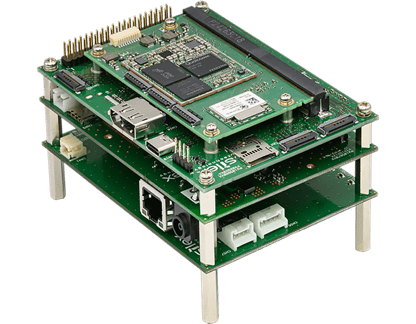
At the hardware level, the EP-200Q-EVK provides the foundation needed for efficient edge inference. Built around the Qualcomm® QCS6490 SoC, it integrates:
- High-performance CPU and NPU for AI workloads
- Low-power operation for embedded environments
- Support for real-time processing
This combination enables on-device inference without relying on cloud connectivity, which is critical for latency-sensitive and privacy-focused applications.
Putting It All Together: Vision-Guided Robotics
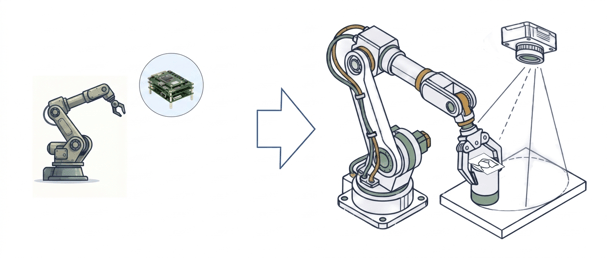
To illustrate how these elements come together, consider a practical implementation: upgrading legacy robotic arms with vision-based intelligence.
System Integration
By combining:
- GStreamer pipelines for video processing
- ROS2 and MoveIt 2 for robotics control
- Edge Impulse object detection models (e.g., FOMO)
developers can create a tightly integrated system that connects perception with action.
Real-Time Decision Making
In this setup:
- The camera captures live video
- The AI model identifies specific individuals
- The system calculates coordinates and plans movement
From Recognition to Action
The result is a fully autonomous loop:
- Detect objects or people
- Interpret spatial information
- Execute robotic movement in real time
This transforms conventional robotic systems into “vision-guided robots,” capable of adapting dynamically to their environment.
Closing the Gap Between Prototype and Production
Edge AI success depends on more than model accuracy, it requires alignment between data, hardware, and operational workflows. By combining the EP-200Q-EVK with the MLOps capabilities of Edge Impulse, developers can:
- Build models tailored to real-world constraints
- Optimize performance for edge hardware
- Maintain and improve systems over time
The result is a shorter path from experimentation to deployment, and a more reliable foundation for next-generation edge AI applications.
Ready to Accelerate Your Edge AI Development?
Moving from a prototype to a reliable deployment requires the right tools and a proven strategy. Download our comprehensive guide to the EP-200Q-EVK to see how you can streamline your workflow and bring high-performance AI to the edge.
Download the EP-200Q Edge AI EVK Guide