


Posted by Sarah Torjman, November 18, 2026
QCS6490 vs. i.MX 95: Which Edge AI Platform Fits Your Application?
The Qualcomm® QCS6490 and the NXP i.MX 95 are both production-ready edge AI platforms, but they optimize for different things. The QCS6490 emphasizes AI throughput and multi-camera vision. The i.MX 95 emphasizes security, functional safety support, and industrial networking. The right choice depends on your workload, operating environment, and compliance requirements.
What Is the Difference Between the QCS6490 and the i.MX 95?
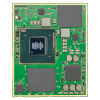
The table compares the Silex SoMs built on each platform: the EP-200Q (QCS6490) and the EP-200N (i.MX 95).
|
Specification |
EP-200Q (QCS6490) |
EP-200N (i.MX 95) |
|
CPU |
8-core Kryo™ 670, up to 2.7 GHz |
6x Arm® Cortex®-A55 up to 1.8 GHz, plus Cortex-M7 and M33 |
|
AI acceleration |
NPU + DSP, up to 12 TOPS |
eIQ® Neutron NPU, 8 eTOPS |
|
Camera inputs |
Up to 5 MIPI CSI |
2 MIPI CSI, up to 8x 1080p30 via virtual channels |
|
Wireless |
Wi-Fi 7 with the SX-PCEBE module (PCIe), featuring Bluetooth 5.4 |
Wi-Fi 6E with the SX-SDMAX6E module (SDIO); driver included in the Yocto BSP |
|
USB & Network Interfaces |
USB 3.1 Type-C with DisplayPort Alt Mode; USB 2.0 OTG |
1x 10GbE + 2x Gb Ethernet with TSN; AVB and IEEE 1588 synchronization; EEE; 1x USB 3.0; 1x USB 2.0 with PHY |
|
PCI Express |
1x PCIe Gen 3 (1-lane) for Wi-Fi; 1x PCIe Gen 3 (2-lane) |
2x PCIe Gen 3 (1-lane) |
|
Peripheral interfaces |
SPI, I²C, UART, GPIO |
Customizable by BSP |
|
Operating temperature |
-25°C to 75°C |
-40°C to 85°C |
|
Size |
35 x 40 mm |
40 x 50 mm |
Which Platform Has More AI Performance?
On published numbers, the QCS6490 AI engine is rated up to 12 TOPS, versus 8 eTOPS for the i.MX 95 NPU. However, TOPS figures from different vendors may be measured differently, and real performance depends on model architecture, precision, memory bandwidth, and software.
Which Platform Is Better for Multi-Camera Vision?
The QCS6490 supports up to five MIPI CSI camera inputs, which suits robots, drones, and smart multi-camera systems. The i.MX 95 includes an NXP-developed ISP, and the EP-200N supports up to eight 1080p30 cameras using MIPI virtual channels. Usually, the camera count, resolution, and frame rate set the requirement, so it's recommended to check the specific configuration you plan to use.
The QCS6490 fits products that value AI performance per watt in mobile and vision-centric designs, with Qualcomm offering over 10 years of longevity for the part.
How Should You Choose?
- Camera count and model size: more cameras and heavier models point toward the QCS6490.
- Safety, security, and compliance: regulated industrial or medical products may point toward the i.MX 95.
- Network type: industrial wired networks (TSN, CAN-FD) and wireless-first designs favor different platforms.
- Environment: compare operating temperature and lifecycle needs.
FAQ
Is the QCS6490 better than the i.MX 95?
Neither is better in every case. The QCS6490 offers higher AI throughput and more camera inputs, while the i.MX 95 offers safety support, security features, and industrial networking.
How many TOPS do I need for edge AI?
It depends on the model, input resolution, frame rate, and latency target. It's recommended to benchmark your own workload rather than relying on TOPS alone.
Which Silex SoM uses each platform?
The EP-200Q uses the QCS6490. The EP-200N uses the i.MX 95.
Ready to Find the Right Edge AI Platform for Your Design?
Whether your application demands high-performance AI processing and multi-camera vision or advanced security, functional safety, and industrial connectivity, Silex has a solution to help accelerate your development.
Explore our System-on-Modules built on the Qualcomm® QCS6490 and NXP i.MX 95 platforms to discover the features, capabilities, and connectivity options that best fit your application.