

%20(2).svg)

As medical and industrial landscapes evolve, the transition to Wi-Fi 6E provides more than just a speed boost, it establishes a new benchmark for device-level security. However, implementing these advanced protocols requires a deep understanding of the intersection between hardware-level encryption and network architecture.
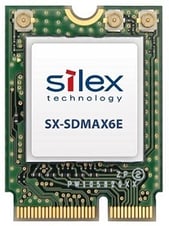
Following our technical webinar with NXP Semiconductors, attended by over 250 industry professionals, we have compiled the most critical engineering questions focused on securing the SX-SDMAX6E (powered by the NXP IW623 chipset). From leveraging hardware-accelerated encryption to navigating mandatory WPA3-Enterprise requirements, this guide provides the security validation needed to ensure your design remains resilient in mission-critical environments.

How do you protect devices from rogue access points?
To prevent devices from connecting to unauthorized or "rogue" signals, the best defense is moving beyond shared passwords. We recommend using WPA3-Enterprise security with 802.1X authentication. By requiring every device to verify its unique identity against a RADIUS server, you ensure only trusted hardware gains access.
The SX-SDMAX6E, powered by the NXP IW623 chipset, fully supports these enterprise-grade security protocols, making it an ideal choice for high-stakes medical and industrial environments where rogue connections aren't just a nuisance, they’re a liability.
How does the 6GHz spectrum in Wi-Fi 6E help medical devices meet FDA wireless coexistence requirements?
While Wi-Fi 6E doesn’t change the FDA regulations themselves, it provides a much cleaner environment for meeting them. The FDA requires medical device manufacturers to demonstrate "wireless coexistence", proving that their device can function reliably even when other wireless signals are present.
By adding the 6GHz frequency spectrum, Wi-Fi 6E opens up dozens of new, uncongested channels. This significantly reduces the risk of interference from legacy devices, making it much easier for engineers to prove stable performance during the compliance process.
Our SX-SDMAX6E, utilizing the NXP IW623 chipset, is built to thrive in these high-density hospital environments. We provide the RF expertise and stable driver support needed to help you navigate FDA requirements for cybersecurity and RF coexistence with confidence.
Are hospitals willing to setup devices on Wi-Fi?
Yes, Wi-Fi is now the standard for transmitting patient data, but hospital IT teams are often stretched thin. To make your device "hospital-friendly," we recommend Zero Touch Provisioning (ZTP). This allows devices to securely and automatically configure themselves the moment they power on, bypassing the need for manual setup by busy IT staff.
At Silex, we’ve spent over 15 years helping medical manufacturers navigate these hospital environments. Our SX-SDMAX6E, featuring the NXP IW623 chipset, provides the stable, high-performance Wi-Fi 6E foundation needed for seamless ZTP deployment, ensuring your device is ready for the modern clinical floor.
What’s the best way to secure IoT devices on Wi-Fi?
The gold standard for IoT security is a layered defense, starting with WPA3-Enterprise. Unlike personal setups that rely on a shared passphrase, WPA3-Enterprise gives every device its own unique credentials through a RADIUS server, ensuring that a single compromised key doesn’t expose your entire fleet.
For application-layer data, encryption via SSL/TLS is essential. The SX-SDMAX6E is uniquely equipped to handle this through its integration with the NXP IW623 chipset, which features a dedicated secure subsystem for cryptographic operations. This subsystem manages heavy cryptographic math and secure key storage, ensuring data remains encrypted at hardware speeds without taxing your main host processor.
Does Wi-Fi 6E make security better by default?
Yes, specifically in the 6GHz band. While switching to Wi-Fi 6 or 6E on older 2.4GHz or 5GHz bands doesn't automatically force a security upgrade, the Wi-Fi Alliance mandates the use of WPA3 encryption for all operations in the new 6GHz spectrum.
This means if you are leveraging the 6GHz band with the SX-SDMAX6E, you are guaranteed enterprise-grade security by default, legacy, less-secure protocols like WPA2 are simply not allowed. By combining this mandatory WPA3 standard with the NXP IW623 chipset’s integrated security features, Silex ensures your transition to the 6GHz spectrum is as secure as it is fast.
Do you recommend separating IoT devices from staff Wi-Fi?
Absolutely. For both reliability and security, segregating your medical or industrial IoT devices onto a dedicated network is a best practice. High-bandwidth activities on a staff network, like video conferencing or large file transfers, can create "network noise" that makes IoT communication unpredictable or slow.
By using a dedicated VLAN or SSID for IoT, you ensure your mission-critical devices aren't competing for airtime. Furthermore, many IoT devices lack the intuitive update mechanisms found in smartphones or laptops. Isolating them prevents a vulnerability in one consumer-grade device from exposing your entire staff infrastructure.
The SX-SDMAX6E, featuring the NXP IW623, is designed for this high-density environment. It supports advanced Wi-Fi 6 features that allow for better "time allocation" on the network, ensuring your device stays responsive even in a crowded hospital setting.
Ready to Secure Your Wi-Fi 6E Design?
Protecting mission-critical data in medical and industrial environments requires more than just the right software, it requires a hardware foundation built for resilience. Whether you are navigating FDA wireless coexistence requirements or implementing WPA3-Enterprise, the right architectural start is critical to your project's success.
Our SX-SDMAX6E Early Access Program is designed to give you the head start you need. By joining, you gain direct access to:
- Detailed Design Files: Accelerate your hardware integration with vetted schematics.
- Security Validation: Technical resources to help you implement robust encryption and authentication.
- Platform Compatibility: Engineering support to ensure seamless operation with your specific NXP host processor and kernel version.
Ready to Secure Your Wi-Fi 6E Design?
Join our program today to move your secure Wi-Fi 6E design from prototype to production.
Apply for Early Access