

%20(2).svg)

Wi-Fi 6E is a system architecture decision, not just a feature upgrade
Wi-Fi 6E combined with Bluetooth® is increasingly used in embedded industrial and medical devices to support high-bandwidth connectivity, real-time data exchange, and wireless communication.
However, successful implementation is not determined by wireless standards alone. In embedded systems, performance and reliability are primarily driven by system architecture decisions, including host interface selection, RF design constraints, coexistence behavior, and power management strategies.
For OEM engineering teams, Wi-Fi 6E integration should be treated as a system-level design challenge, not a component-level upgrade.
Why Wi-Fi 6E matters in embedded industrial and medical environments
Wi-Fi 6E extends Wi-Fi operation into the 6 GHz band, in addition to traditional 2.4 GHz and 5 GHz bands. This expansion is particularly relevant for RF-dense environments such as:
- Hospitals and medical facilities
- Industrial automation environments
- Logistics and warehouse systems
- Smart manufacturing and robotics platforms
Key embedded benefits of Wi-Fi 6E
- Reduced RF interference compared to legacy bands
- Increased number of available channels
- Improved performance stability in congested environments
- More consistent behavior under multi-device load
In embedded systems, Wi-Fi 6E value is primarily derived from improved spectrum availability and reliability, rather than peak throughput improvements.
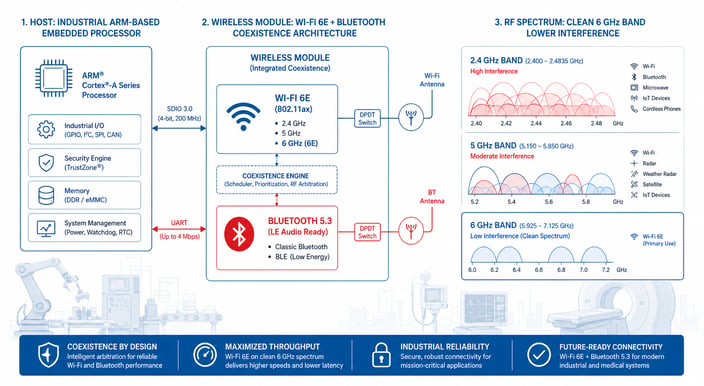
Embedded wireless design is constrained by system-level factors
Unlike consumer devices, industrial and medical embedded systems must account for multiple design constraints simultaneously:
- RF performance in compact enclosures
- Power consumption across operational states
- Coexistence between multiple wireless radios
- Host processor and interface limitations
- Long lifecycle and OS version variability
- Regulatory certification requirements
These constraints mean that wireless selection decisions must be evaluated within the context of the full system architecture.
SDIO vs PCIe for embedded Wi-Fi 6E systems
One of the most important architectural decisions in embedded wireless design is the host interface: SDIO or PCIe.
SDIO-based architectures in embedded systems
SDIO is widely used in embedded applications due to its balance of simplicity and efficiency. It is commonly selected for:
- ARM-based embedded Linux platforms
- Battery-powered or power-sensitive devices
- Industrial and medical embedded systems
- Moderate-throughput wireless applications
Advantages of SDIO
- Lower system complexity and BOM overhead
- Reduced host interface power consumption
- Simplified integration with embedded SoCs
- Sufficient throughput for most IoT and industrial workloads
- Stable behavior in constrained embedded environments
PCIe-based architectures in embedded systems
PCIe is typically used in higher-performance computing platforms requiring sustained high throughput.
Characteristics of PCIe
- High bandwidth capability
- Suitable for edge computing and compute-intensive workloads
- Higher system power consumption
- Increased PCB and integration complexity
Evaluating Wi-Fi 6E & Bluetooth for your embedded system design?
Discuss your architecture requirements with a Silex wireless connectivity expert to better understand host interface tradeoffs, coexistence considerations, and integration constraints for industrial and medical applications.
Contact an ExpertIn many embedded industrial and medical applications, PCIe performance exceeds actual system requirements, making SDIO-based architectures more efficient from a system design perspective.
Wi-Fi and Bluetooth coexistence challenges in embedded systems
Most embedded wireless designs require both Wi-Fi and Bluetooth functionality. This introduces RF coexistence challenges that must be addressed at the system level.
Common coexistence challenges
- RF interference between Wi-Fi and Bluetooth transmissions
- Bluetooth latency variability during Wi-Fi traffic spikes
- Reduced performance under simultaneous operation
- Antenna coupling limitations in compact hardware designs
Impact on embedded applications
These challenges can directly affect system behavior in:
- Medical monitoring devices requiring stable sensor communication
- Industrial handhelds using Bluetooth peripherals
- Robotics and automation systems requiring deterministic control links
Effective coexistence design requires coordination across firmware scheduling, RF layout, and system-level traffic management.
Power consumption in Wi-Fi 6E + Bluetooth embedded systems
Power efficiency in embedded wireless systems is not defined solely by active transmit/receive currents. Instead, real-world energy consumption depends on:
- Sleep and standby state efficiency
- Wake-up latency and frequency
- Power management strategies
- Traffic burst handling behavior
- Multi-radio coexistence overhead
Key insight
Peak power values do not accurately reflect real-world system energy consumption. Instead, long-term efficiency depends on how effectively the system manages transitions between active and low-power states.
For battery-powered industrial and medical devices, optimizing low-power behavior is often more important than optimizing peak throughput performance.
Integration complexity and lifecycle considerations
In industrial and medical OEM environments, wireless integration must be evaluated over the full product lifecycle.
Key engineering risks
- Driver compatibility
- RF tuning requirements across product variants
- Coexistence validation under real-world traffic
- Certification revalidation triggered by hardware changes
- Long-term component availability and stability
Reducing system variability at the architectural level can help reduce development effort during integration, validation, and certification phases.
Practical evaluation criteria for embedded Wi-Fi 6E + Bluetooth modules
When selecting a wireless solution for embedded systems, engineering teams should focus on system-level criteria rather than only RF specifications:
Key questions to evaluate
- Does the host interface match system power and performance constraints?
- How predictable is coexistence behavior under simultaneous operation?
- What level of RF and software integration effort is required?
- How stable is driver support across OS and kernel versions?
- How does the solution impact certification and validation complexity?
Key takeaway
In embedded industrial and medical systems, long-term reliability and integration predictability are typically more important than maximum theoretical wireless performance.
Conclusion: embedded wireless success depends on architecture, not specifications
Wi-Fi 6E and Bluetooth provide significant advantages for modern embedded systems, particularly in terms of spectrum availability and RF performance in congested environments.
However, successful implementation depends on architectural decisions around:
- Host interface selection (SDIO vs PCIe)
- RF coexistence design
- Power management strategy
- System integration complexity
- Lifecycle and certification constraints
For industrial and medical OEMs, the most effective wireless designs are those that prioritize predictable system behavior, integration efficiency, and lifecycle stability over peak performance metrics.
Need help selecting the right Wi-Fi 6E & Bluetooth solution?
Speak with a Silex wireless connectivity expert to review your embedded system requirements, architecture constraints, and integration considerations for industrial and medical applications.
Contact an Expert