

%20(2).svg)

Posted by Sarah Torjman, October 1, 2026
Why Edge AI Is Moving Intelligence Closer to the Device
Artificial intelligence is increasingly moving beyond the cloud and closer to where data is created: the device itself. This shift, known as Edge AI, enables intelligent devices to process data and perform AI inference closer to the point where information is generated.
From robotics and industrial automation to machine vision, healthcare and smart connected devices, Edge AI is creating new possibilities for how products are designed and how they respond to their environments.
But what is driving this shift, and what does it take to build an Edge AI device?
What Is Edge AI?
Edge AI is the deployment of artificial intelligence and machine learning capabilities on an edge device or close to where data is generated.
Rather than sending all data to a remote cloud or data center for processing, an Edge AI system can perform some AI workloads locally.
This approach can be useful for applications that require:
- Real-time or low-latency processing
- Reduced dependence on cloud connectivity
- Local data processing
- Efficient use of network bandwidth
- Greater control over where data is processed
For example, a vision-based system can analyze camera data locally to identify objects or detect changes in its environment, allowing the device to respond without sending every frame to a remote system.
Why Is AI Moving to the Edge?
Cloud computing remains an important part of many AI architectures. However, some applications benefit from performing AI processing closer to the source of the data.
Lower Latency
Applications such as robotics, machine vision and industrial automation may require rapid responses. Processing data locally can reduce the communication time associated with sending data to a remote system and waiting for a response.
Reduced Network Dependence
An Edge AI device can perform certain AI workloads locally rather than depending on continuous connectivity to a cloud service. This can be useful in industrial environments, mobile equipment and other applications where network availability may vary.
Data Processing at the Device
Some applications involve sensitive or high-volume data. Processing information locally can reduce the amount of raw data that needs to be transmitted elsewhere, depending on the system architecture and application requirements.
Efficient Use of Bandwidth
Cameras and other sensors can generate significant amounts of data. An edge device can process information locally and transmit selected results or other relevant information rather than continuously sending all raw data to the cloud.
What Does an Edge AI Device Need?
Building an intelligent edge device involves more than selecting an AI-capable processor.
Engineers need to consider the complete system, including:
- Processing performance
- AI acceleration
- Memory
- I/O and interfaces
- Connectivity
- Power consumption
- Security
- Software support
- Product size and deployment requirements
This is one reason system-on-module (SOM) platforms can be useful for developers building Edge AI products.
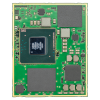
A SOM integrates key computing components into a compact module, providing a foundation that developers can incorporate into a larger product design. Depending on the platform, a SOM may include the processor, memory, storage, power management and other essential components.
Using a SOM can give developers a starting point for their computing platform while allowing them to focus their engineering resources on the application and product itself.
The Role of AI-Capable Processors
Modern Edge AI systems increasingly combine AI-capable processors with memory, I/O, connectivity and software designed to support the requirements of intelligent edge devices.
For example, Qualcomm’s QCS6490 combines high-performance computing with an AI engine designed to support edge AI workloads. Qualcomm identifies applications including robotics, smart vision, manufacturing and other enterprise and commercial IoT use cases.
Similarly, NXP's i.MX 95 applications processor family combines AI-accelerated vision processing with high-performance connectivity, advanced security and functional safety capabilities for edge applications. The platform incorporates NXP's eIQ Neutron NPU for machine learning acceleration.
These are examples of how modern processing platforms are bringing more computing and AI capabilities directly into edge devices.
Edge AI and Connectivity
AI processing is only one part of an intelligent edge device.
Many Edge AI applications also need to communicate with other devices, networks or cloud services. As a result, connectivity can be an important consideration when designing the overall system architecture.
For example, a smart industrial device might process sensor information locally, make an AI-driven decision and then use a wireless or wired connection to communicate selected information to another system.
Combining computing, AI processing and connectivity at the device level can help developers build intelligent products that operate as part of a larger connected system.
Where Is Edge AI Being Used?
Edge AI can support a wide range of applications, including:
Robotics
Local AI and vision processing can help robots interpret their surroundings and respond to changing conditions.
Industrial Automation
Edge devices can analyze equipment and sensor data locally for monitoring, inspection and other intelligent applications.
Machine Vision
AI inference at the edge can enable real-time image and video analysis while reducing the need to continuously transmit raw data.
Healthcare
Edge processing can support intelligent medical and healthcare devices where responsiveness, reliability and data handling are important considerations.
Smart Connected Devices
AI-enabled devices can analyze information locally while maintaining connectivity with other systems and cloud services.
What Comes Next for Edge AI?
As AI capabilities become more accessible on embedded platforms, developers have more options for incorporating intelligence directly into connected products.
The challenge is not simply determining whether AI belongs in a product. Engineers also need to consider where AI processing should happen, what computing architecture is appropriate, and how AI fits with connectivity, security, power and the rest of the system.
SOM platforms provide one approach by giving developers a foundation for integrating computing capabilities into intelligent, connected products.
As Edge AI continues to evolve, technologies such as Qualcomm's QCS6490 and NXP's i.MX 95 are helping expand the capabilities available for intelligent edge applications.
For developers exploring Edge AI, understanding the relationship between processing, AI acceleration, connectivity and the overall system architecture is an important first step toward building the next generation of intelligent devices.
Explore Silex's Edge AI SOM Solutions
Explore Silex's Edge AI SOM solutions to learn more about platforms for intelligent, connected products.