

%20(2).svg)

Posted by Sarah Torjman, April 16, 2026
Solving the I/O Bottleneck in Edge AI Systems
In modern Edge AI design, the "I/O Bottleneck" can be a common development hurdle. Whether you are developing an autonomous mobile robot (AMR) requiring 360-degree situational awareness or a high-end medical workstation driving multiple 4K displays, you shouldn't have to sacrifice sensor data for processing speed.
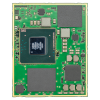
Most System-on-Modules (SoMs) lock you into a rigid configuration that forces you to compromise on your peripheral vision or display quality. The Silex EP-200Q is different. Engineered to serve as the "Central Nervous System" for I/O-intensive applications, it exposes nearly every interface of the Qualcomm QCS6490 SoC through its 500-pin LGA pads.
From Sensors to Insights: Mapping the Interface Potential
The EP-200Q provides the architectural foundation for your most complex sub-systems. By offloading AI inference to the onboard NPU, you free up the CPU to manage these high-bandwidth I/O (Input/Output) streams in real-time.
Table: EP-200Q Technical Interface Capabilities
|
System Function |
Interface Specification |
Example Use Case |
|
Advanced Vision |
5x 4-lane MIPI CSI |
Connect 5 high-speed cameras for 360° situational awareness for AMRs. |
|
Immersive UI |
MIPI DSI, eDP 1.4, DisplayPort over USB-C |
Drive three independent high-resolution (4K) displays for medical imaging. |
|
High-Speed Networking |
2x PCIe Gen 3 (Lanes 1 and 2) |
Native support for Wi-Fi 7 modules (e.g., SX-PCEBE) or high-speed bridge ICs. |
|
System I/O & Control |
Multiple SPI, I2C, UART, GPIOs |
Flexible integration of legacy sensors, actuators, and standard peripherals. |
|
Professional Audio |
SoundWire, SLIMbus, 3x Digital Mic Ports |
Crystal-clear audio for medical diagnostics or voice-activated robotics. |
|
Peripheral Expansion |
USB 3.1 Gen1 Type-C, USB 2.0 OTB, 4-bit SDIO |
Connect external drives, debug tools, or expandable memory. |
Designing a multi-camera or multi-display system? See what interfaces are possible in our EVK Guide.
The Silex Advantage: Hardware That Adapts to Your Design
The biggest hurdle in SoM integration is often the "Fixed Pinout" trap, where the hardware manufacturer’s software doesn't match your physical layout.
As an official Qualcomm Embedded Design Center (EDC), Silex removes this risk. We don't just provide the hardware; we provide the Custom Board Support Package (BSP).
If your design requires repurposing a pre-assigned interface, such as swapping a PCIe lane for additional UARTs or GPIOs, our engineering team handles the low-level firmware architecture for you. We deliver a tailored BSP that matches your specific pinout requirements, allowing your team to focus on application-level innovation rather than kernel-level troubleshooting.
Stop Researching. Start Prototyping.
Don’t let I/O constraints or complex firmware setup stall your build. The EP-200Q Evaluation Kit is a pre-validated environment designed to bypass the "setup phase" and get you straight to development.
Download the EVK Guide to get:
- Hardware Mapping: Complete pinout details for MIPI CSI, CAN-FD, and PCIe expansion.
- Out-of-the-Box AI: A preview of 16+ ready-to-run samples, including real-time object detection and pose estimation.
- The Development Roadmap: A breakdown of our Docker-based setup and Yocto firmware migration paths.