

%20(2).svg)

Edge AI systems are increasingly expected to do more than process data locally. In applications such as mobile robotics, industrial automation, and machine vision, devices may need to analyze camera or sensor data while maintaining a reliable connection to other devices, networks, or remote operators.
For engineers designing these systems, one question is especially important: How do you add wireless connectivity to an Edge AI platform without creating unnecessary integration complexity?
One common approach is to combine a System-on-Module (SoM) with a dedicated wireless module.
What Role Does the SoM Play?
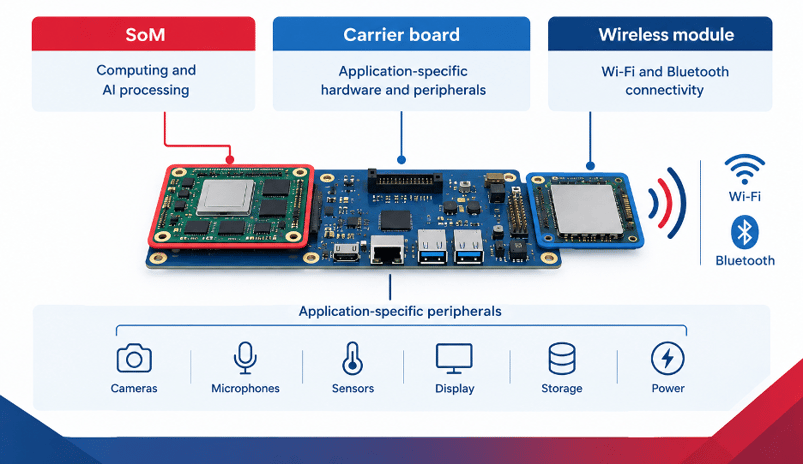
A System-on-Module provides the computing foundation for an embedded product. Instead of designing the processor, memory, and other core computing functions directly onto a custom PCB, developers can build their application around a pre-engineered computing module.
In an Edge AI application, the SoM can provide the processing resources needed to run application software, process camera or sensor data, and perform AI inference locally.
The SoM is then connected to a carrier board designed for the specific product. The carrier board can provide connections to cameras, sensors, displays, storage, power, networking, and other peripherals required by the application.
But computing is only one part of a connected edge system.
How Do You Add Wi-Fi to an Embedded SoM?
Wireless connectivity can be implemented through a dedicated wireless module connected to the host platform through an appropriate interface.
For example, a PCIe-based Wi-Fi module can connect to a host platform that supports PCIe. The wireless module handles the radio functions, while the host system runs the operating system, applications, and other processing workloads.
The overall architecture can be thought of simply as the following:
The software integration between these components is also important. Engineers need appropriate drivers and operating-system support so the host platform can communicate with the wireless hardware and applications can use the network connection.
Why Does Integration Matter?
Adding a wireless module to an embedded design involves more than connecting hardware. Engineers may need to address driver support, operating-system compatibility, interface configuration, antenna implementation, power requirements, and system validation.
Using components with established hardware and software support can help reduce some of this integration effort.
For Edge AI applications, this can be particularly important because the wireless connection may be carrying video, sensor information, control data, or other application traffic while the system is simultaneously performing AI workloads locally.
Putting the Architecture Into Practice
Consider a mobile industrial robot equipped with cameras and microphones.
The Edge AI SoM can process camera and audio data locally and run the application's AI workloads. A wireless module can provide the Wi-Fi connection that allows the robot to communicate with a remote operator or other networked systems.
In this architecture, the two components have different jobs but work together as part of the same embedded system:
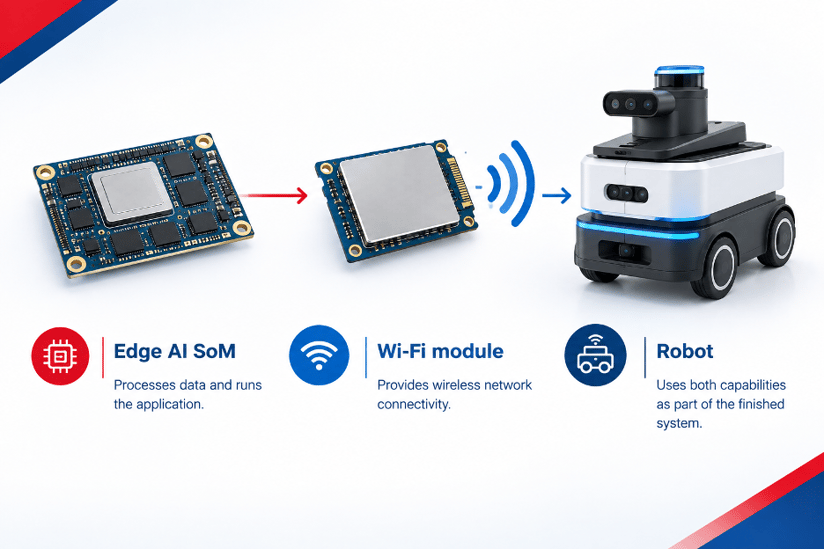
Silex applies this approach with the EP-200Q, an Edge AI SoM based on the Qualcomm QCS6490, and the SX-PCEBE, a PCIe Wi-Fi 7 and Bluetooth 5.4 combo module. Silex provides Wi-Fi driver support for integrating the SX-PCEBE with the EP-200Q platform.
The same architecture can support applications where local AI processing and wireless communication need to operate together, including mobile robotics, machine vision, and industrial automation.
See Edge AI and Wi-Fi 7 in Action
Want to see how an Edge AI platform and wireless connectivity can work together in a real application?
Silex Technology will be at Embedded World North America 2026, September 22–24, in Anaheim, California. Visit Booth #5823 and stop by the Robotics Lab to see a live demonstration featuring Silex’s EP-200Q Edge AI SoM and SX-PCEBE Wi-Fi 7 + Bluetooth wireless module.
Explore the EP-200Q
Learn more about the EP-200Q Edge AI SoM and its capabilities for on-device AI applications.